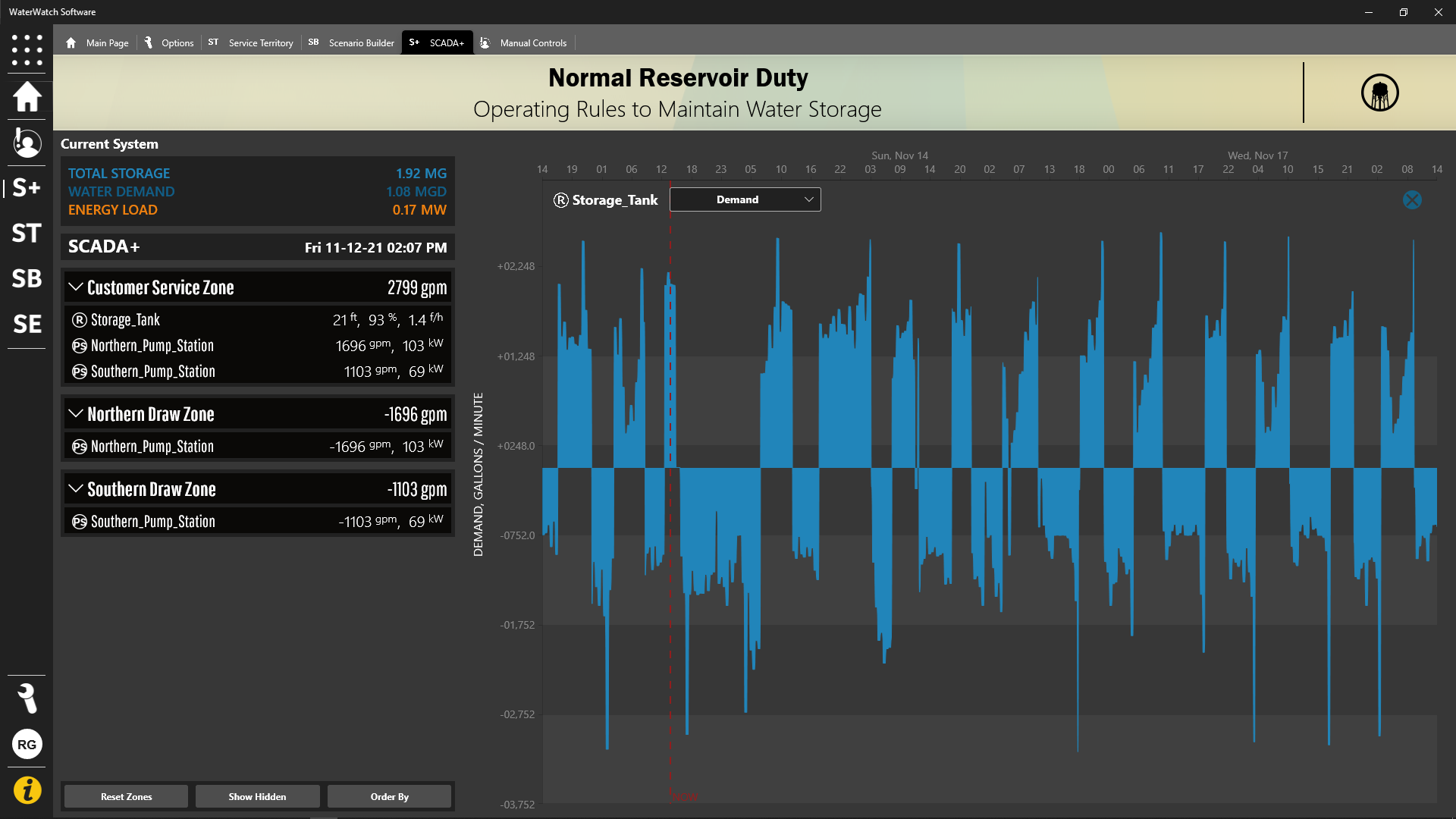
The next generation of water distribution system management is a decision support application that provides extensive data integration for improved forecasts and operations. Our WaterWatch Software merges all water system data sources and creates a central repository of hydraulic simulation, data management review and reporting to address key questions you have about your water system.
WaterWatch Software provides valid operational recommendations by leveraging engineering principles of hydraulic models combined with operations analytics and optimization algorithms that allow water distribution systems to safely and securely:
- Forecast future utility operations, energy demands, and energy costs;
- Generate new utility operating strategies;
- Facilitate energy demand response participation at the utility; and
- Empower water utility operators to proactively explore new operations based on future energy rate structures or energy demand response programs.
How it Works
WaterWatch Software enables you to integrate water utility data sources to provide accurate, real-time forecasting and operational simulation of complex water systems. Water agencies can visualize system performance at multiple scales to inform operational decisions, perform long-term infrastructure planning, and more efficiently generate comprehensive reports for the system, assets, and at the customer-level.
Rapidly Compare Chosen Scenarios
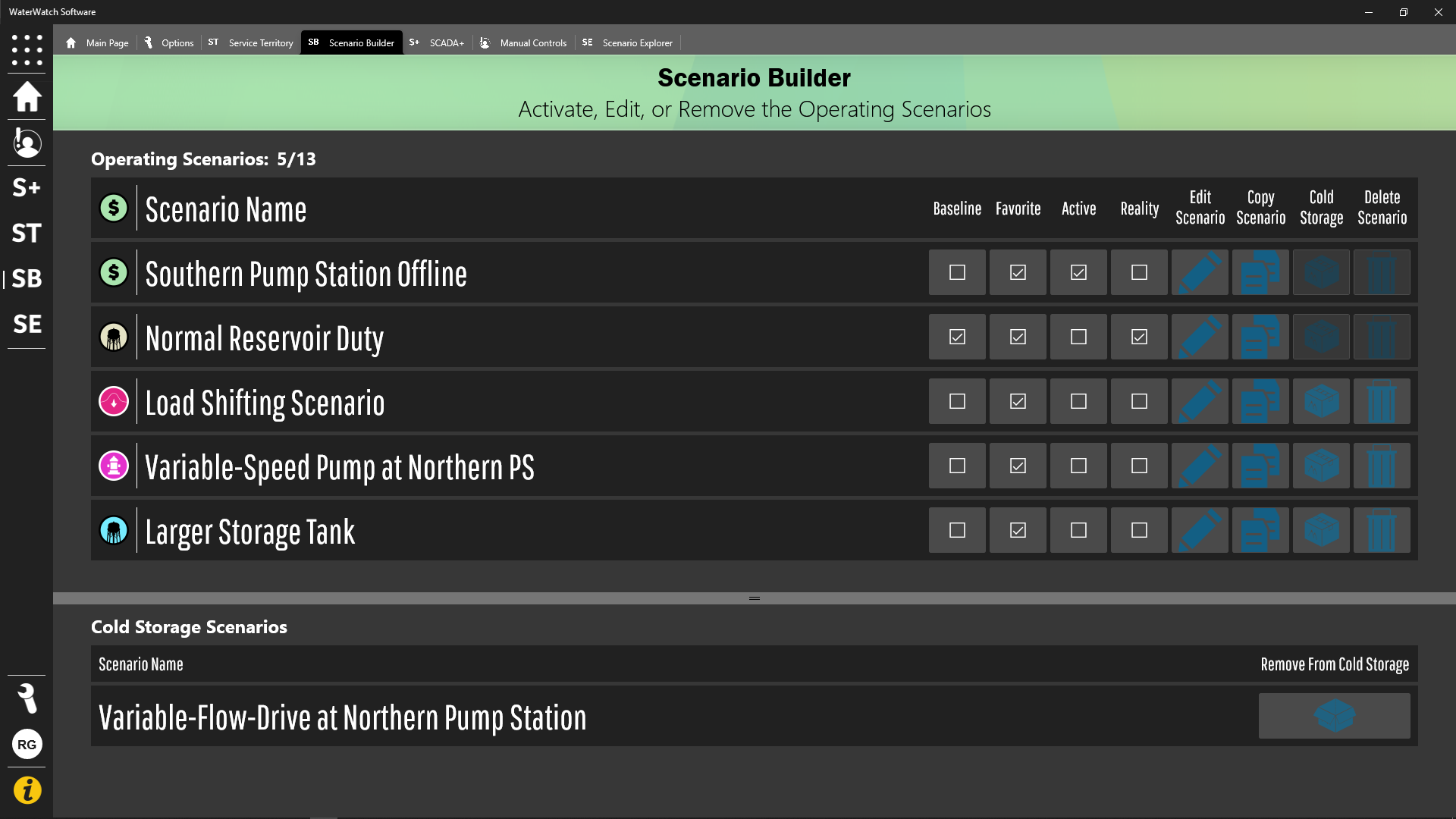
In WaterWatch, you can create and maintain many different operational scenarios using the Scenario Builder. Each scenario is automatically simulated and kept up-to-date without ever needing to press “play”. Add custom controls to your hydraulic model using machine learning, PID algorithms, optimized policies, and more.
Compare Operational Performance
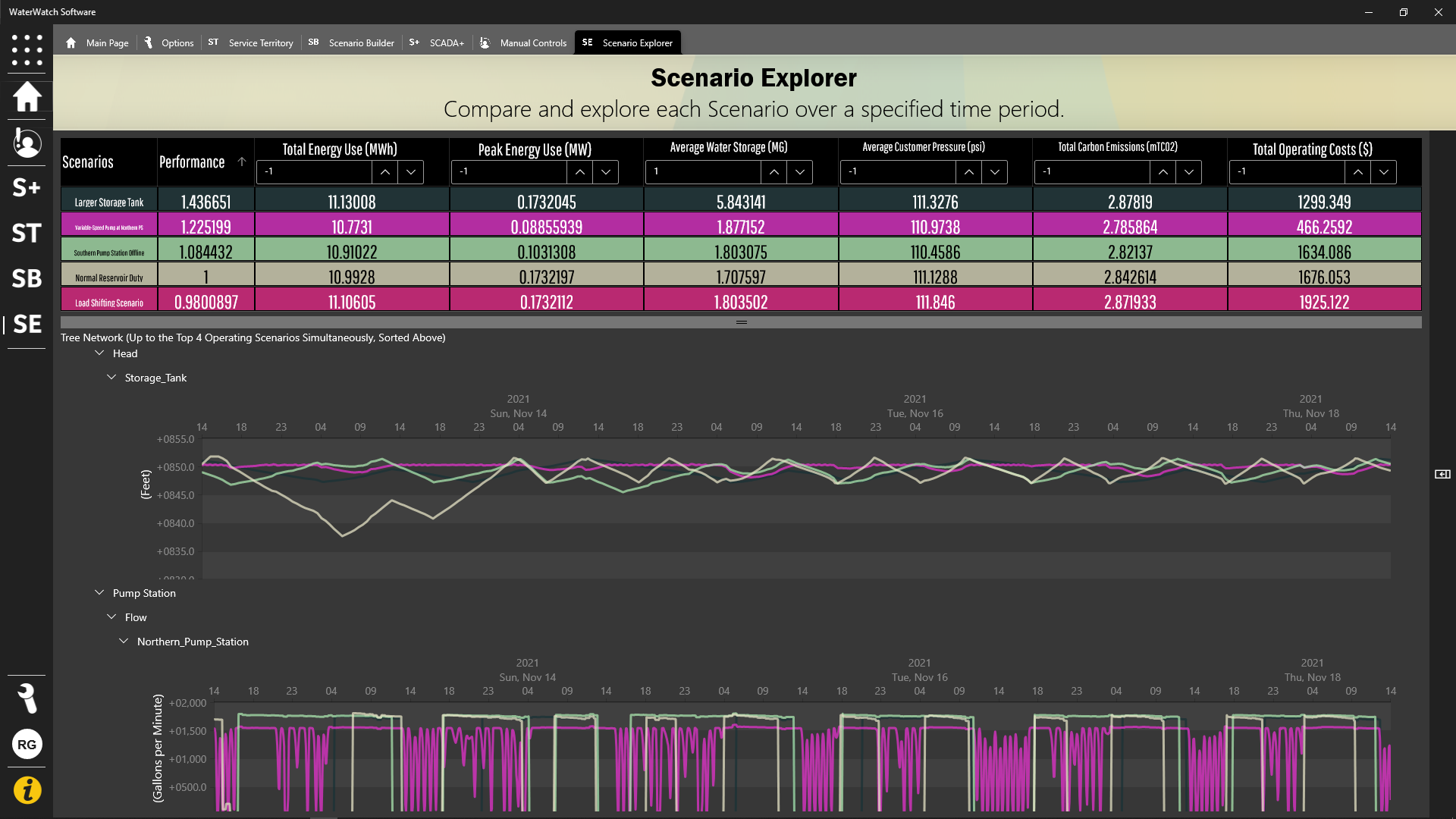
The Scenario Explorer allows for dynamic, rapid comparison of your scenarios simultaneously. Rate scenarios based on your custom, weighted preferences. Automatically align and compare reservoir levels, energy prices, pump flows, valve settings, and much more. Receive simulated measurements for as far back as you have data and the next six days. It forecasts and compares simulated operating scenarios for maintenance, resource usage, or infrastructure improvements.
Operating Schedule Roadmap
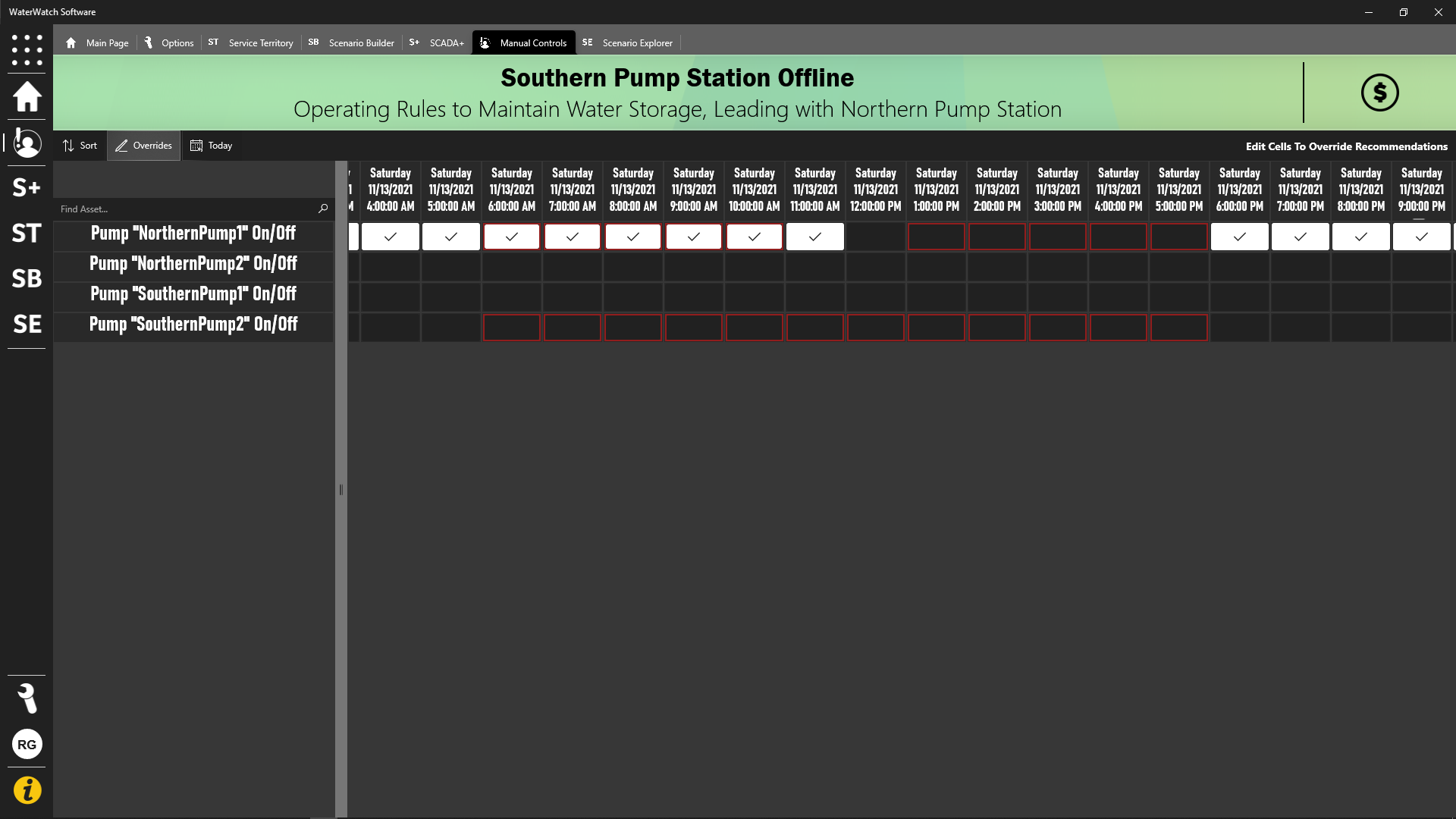
WaterWatch introduces the first interactive hydraulic forecast that allows the operator to match real-life operations to the recommendations from the simulated results. Operators can also quickly override any simulated control without needing to fiddle with complex rules or programming.
Utility Applications
- Manage water system resources
- Improve energy demand management
- Participate in energy demand response programs
- Forecast water storage after operational changes
- Prioritize capital improvement projects
- Respond to real world changes
- Audit leak loss
- Improve water conservation programs
- Generate high-resolution energy intensity reports
Functions and Features
- Analyze assets at all levels
- Forecast long-term policy changes and scenarios
- Stream from prominent data sources for forecasts
- Fill data gaps automatically with machine learning
- Customize the open source software to agency needs
- Smoothly operate a user friendly interface even with large datasets
Impact and Partnership
As a rapid decision support system, WaterWatch Software is unique in its ability to quickly and accurately provide operational intelligence for all aspects of water system management, without the time commitment or specialized engineering skills required to use water system models like EPANET. WaterWatch Software is designed to be a water system operator’s daily companion, helping to answer any sort of “what if” scenario to refine the ability of operators to make decisions to meet new objectives. The software tool brings the hydraulic model into the operations room for long- or short-term system analysis. It allows for continuous evaluation of current situations, instead of waiting for engineering modeling studies which only evaluate a moment in time. It is a collaboration tool for water system engineers, planners, and operators to work together to take system management to the next level and optimize resources in ways never possible before.
WaterWatch Software is a research tool built at UC Davis to improve our management and operations of water distribution systems through the advanced ability to evaluate current or future operations rapidly and continuously using real-time system data. There is no other software product on the market with equal capabilities.
UC Davis is launching this software with the potential to be as impactful as the EPANET software but for the water sector. This software is for utilities who value innovation and exploration, and are interested in advancing the next generation of modern water system resource management.
Since the tool integrates all water system data and its hydraulic model, there are endless opportunities for configuring the software to meet any objective. The WaterWatch User Group will have a direct stake in deciding the priorities for software development with a seat on the Advisory Board. Early users will also obtain significantly discounted rates. Our vision is for WaterWatch Software to be a collaborative software tool for the water sector community to propel and advance the solutions that matter most to water utilities.
Minimum Requirements
- SCADA data available (minimum of reservoir levels and pump flow)
- Hydraulic model compatible with EPANet
You're Invited
Project Background and Support
This effort was funded by the California Energy Commission project EPC 16-062, ‘Advancing Energy Demand Response in the Water Sector.’ The project goal is to develop and pilot a technology that would enable water utilities to participate in an increasingly dynamic energy market, while continuing to provide safe and reliable water to their customers. The end product, WaterWatch, is a comprehensive software that goes beyond energy management. Our pilot site partner is the Moulton Niguel Water District where our technology solution is being tested throughout 2021 in their existing water distribution systems to increase the flexibility of energy management and decrease energy costs. We have also partnered with the California Water Efficiency Partnership (CalWEP) to increase the user base of our products and administer the user support program.
Frequently Asked Questions
What does this software do?
What organizations would benefit the most from using this software suite?
What are the programmatic possibilities from using the software suite?
What are real world applications and capabilities a water utility can expect?
What top features would executives and program managers be most interested in?
- Various reputable historical and real-time data sources are integrated to provide accurate and optimized scenario forecasts such as:
- Weather (historical and forecast)
- Marginal GHG Emission Factors
- Energy price data
- SCADA
- Customer Billing
- GIS map backgrounds
- Staff will interact with a user friendly and familiar Windows environment to generate and compare countless operational scenarios (e.g., optimizations for customer demand, resource management, load shifting, etc.) for improved resource management. It integrates well into existing business operations and does not require computer upgrade improvements.
- Early adopters can work directly with researchers and developers to advise on additional features and add-ons that would be beneficial to impacting 21st Century resource demand management.
What is unique about this software and its roll out?
- Early adopters will have the opportunity to partner with UC Davis CWEE and its developers to direct the customization of the software to bring about the vision of a modern water resources management tool.
- WaterWatch Software has the capability to accurately generate safe, long-term operating policies for any pump or valve. Accurate simulation and forecasts can be provided due to behind-the-scenes machine learning mechanics that aid in filling in gaps of incomplete datasets.
- Assets in WaterWatch can be controlled in one of three ways:
- Operational strategy (e.g., reservoir level controls, pressure controls, etc.)
- Machine learning (i.e. learn from SCADA the actual decisions); or
- User controlled (e.g., operator override for specific periods such as maintenance, pump rotation, etc.)
- The software constantly reruns full hydraulic simulations (instead of performing a limited mass balance) to inform accurate results and give high-resolution forecasts. Additionally, the software can immediately incorporate any updated change (automatic or manual) and provide a new hydraulic forecast and recommendation report automatically without the user needing to click anything.
- Even at a high resolution, the software has the capacity to smoothly support simultaneous calculations and scenario processing (e.g., the user can create a new scenario while simultaneously machine learning SCADA and forecasting the hydraulics).
- Our software has integrated several premium features including real-time data connections, optimizations tools, machine learning tools, automated reporting, and much more.
What is the benefit of long term policy generation?
What is machine learning and how does its implementation benefit utilities?
What kinds of assets and/or variables can an operator control?
- Pumps: status and RPM
- Valves: status and settings
- Pump Stations: energy price structure, greenhouse gas emission factors
What kinds of scenarios can an operator control for?
- “Pump Station is Offline”: the user would disable a pump station‘s controls due to maintenance and the remaining assets will follow their policies to operate without the pump station.
- “Energy Demand Response”: the user adds a policy to pumps that pre-fill their water storage before 5pm, and deactivates their pumps between the hours of 5pm and 8pm.
- “Optimized Energy”: the user utilizes the optimization tools within WaterWatch to generate new operating policies (or strategies) for all pumps to minimize total energy use.
- “Isolated Zone”: the user deactivates all supplies into a DMA and reviews the hydraulics to report the time until a water storage reservoir would drain to the target level.
What are future functionalities researchers are working on integrating into WaterWatch?
- Energy intensity calculations
- Asset management tools
- Pipe break frequency reporting
- Evaluate water and energy conservation measures and benefits
- Leak loss detection and approximation
- Hydraulic model construction and editing tools
- User-defined report generation
- User-defined water demand event (e.g., drought scenario)
- Advanced policy optimizations techniques
- Recommended creation of new district metered areas
- Mac OS compatibility
What can users expect in terms of support and what is the cost?
UC Davis CWEE and CalWEP have partnered to establish an ongoing Support Program with the goals of 1) expanding stakeholder engagement, 2) broadening the user base, 3) providing ongoing technical support, and 4) responding to feedback for software and feature development. Tiered annual subscriptions will fund the not-for-profit activities as outlined in Figure 1. Subscribers will not only have access to the software, they will be part of the overall initiative to further expand on the environment and its software offerings, including the development of additional WaterWatch features .
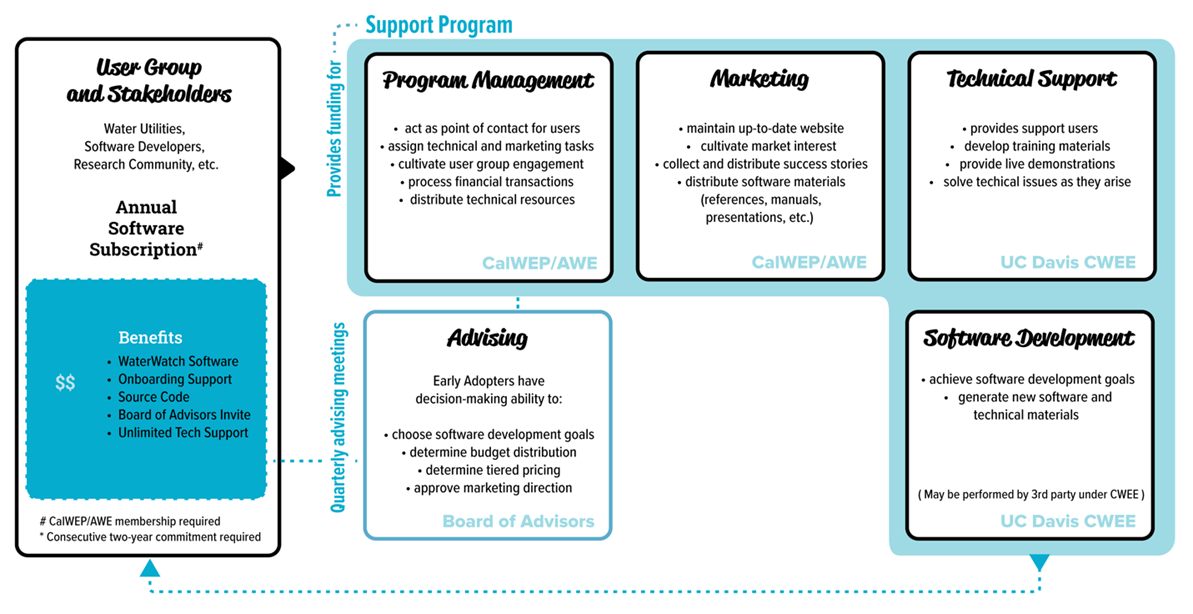
Figure 1: Early Adopter subscriptions will fund the not-for-profit activities to support, market, and continually develop the software suite UC Davis CWEE intends to continually develop and support the integration of WaterWatch Software within the water distribution systems across the country. CalWEP and the Alliance for Water Efficiency (AWE) will oversee program management, develop educational materials and webinars, and market the software suite in order to grow the user base, thereby increasing the number of collaborative opportunities available to existing users. UC Davis CWEE will focus on providing technical support and ongoing software development.Early Adopters will be invited to join the Board of Advisors to steer product development, approve industry marketing direction, and advise on tiered rate pricing. Membership with CalWEP/AWE is required.Annual subscription rates are informed by market interest, costs to the organizations running the program, market pricing for similar products, grants available to subsidize the cost, among other factors. Management of this program is on a non-profit basis. Funding generated will be split into base annual costs to fund program operation as shown in the diagram above, and the remaining toward software development.